Showing posts with label BS. Show all posts

Tuesday, November 13, 2007

Relay

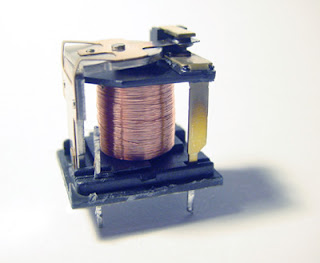
A relay is a simple electromechanical switch made up of an electromagnet and a set of contacts. Relays are found hidden in all sorts of devices. In fact, some of the first computers ever built used relays to implement Boolean gates.

An open relay

Mechanical Relay

Mechanical Switching - Relays
A relay consists of an electromagnet (a coil around a iron bar) that can automatically cause one or more switches to move between to contacts. When current is applied to the electomagnet the switch moves towards the magnet, otherwise the switch is in its "normal" position. By wiring one of the switches into the electromagnetic circuit the relay can be made to remember and thus act as a storage device. In general a relay can be used to make other switches in second and third circuits to move.


From http://www.howstuffworks.com

A relay is so-called since it "relays" or copies an action at one point to another. With simple modifications a relay can duplicate a single action into multiple copies, and even remember an action, thus creating a simple memory device.

Wednesday, September 19, 2007

Cable Outer Sheath PVC vs PE

Polyvinyl Chloride (PVC)

Polyvinyl chloride is basically a hard thermoplastic, but by blending with certain plasticisers a range of general purpose flexible cable compounds of varying degrees of softness can be produced. By the use of selected plasticisers and other additives, grades of PVC can be made which are suitable for either hot or cold ambient temperatures.

Properties

Polyvinyl chloride is a good general purpose thermoplastic. It has good mechanical and ageing properties, and excellent resistance to ozone and weather. It is preferable to pigment it with carbon black to obtain optimum resistance to the effects of sunlight.

Cables insulated and sheathed with PVC will operate satisfactorily when exposed to or immersed in salt or fresh water. Standard PVC compounds are reasonably flame retardant and this property can be improved by special compounding techniques. In general PVC has good resistance to chemicals but affected by solvents and some oils which tend to leach out of the plasticiser and thus cause embrittlement. The so-called 'Heat resisting' grades of PVC have good ageing characteristics at elevated temperatures, but suffer in common with general purpose grades of the tendency to deform under pressure as the temperatures approaches the melting point of the PVC (approx. 130°C). The insulation resistance of PVC is lower than that of some plastics but more than adequate for most wiring applications.

Compared with elastomers, PVC and other thermoplastic materials are susceptible to temperature variations, and they become progressively less flexible as the ambient temperature is lowered.

In general PVC cables should not be installed when the temperature is below 0°C unless the cables have been stored above this temperature for the previous 24 hours. Failure to observe this precaution may result in cracking or shattering of the PVC.

Uses

PVC is used extensively for general wiring cables, low voltage mains cable, domestic flexibles, telephone cable and instrument wiring. It is widely used as a corrosion resistant coating over lead and aluminium sheathed cables.

The maximum continuous operating temperature of general purpose compounds is specified as 70°C and for heat resisting grades as 85°C.

Polyethylene (Polythene)

Polyethylene is a thermoplastic obtained by the polymerisation of ethylene. Depending on the particular polymerisation technique used, polyethylene of varying densities and molecular weight can be produced, and these can therefore be broadly classified as either low or high density polyethylene.

Properties

Polyethylene has extremely good electrical characteristics and excellent resistance to water, chemicals and some solvents. However, it has only moderate resistance to oils and has the disadvantage of being flammable. The low temperature properties of polyethylene are good. It is customary to pigment with carbon black both high and low density polyethylene, to improve their resistance to weather. Polyethylene is an excellent insulation for high voltage cables, but when extruding thick layers of dielectric, care has to be taken to prevent the inclusion of voids during this process. Polyethylene has a melting point of about 110°C-115°C which is a serious disadvantage for cables liable to be subjected to short circuit and overload conditions; this is one of the reasons why the use of this material has discontinued for the insulation of general wiring cables.

Uses

Polyethylene is extensively used either in the solid or expanded form for the insulation of communication cables. One major application is for the insulation of coaxial cable for television downleads, and another is for the insulation of multicore telephone cables where its excellent electrical properties enable a thin small radial wall of insulation to be employed. Polyethylene is used for submarine cables and in some types of high voltage cables. High density polyethylene can be used as an external sheath on cables to provide corrosion protection.

The recommended continuous operating temperature of polyethylene is normally stated as 70°C, to allow a factor of safety for overloads up to a maximum temperature of 90°C.

Wednesday, July 18, 2007

COMPARISON OF GRP/FRP CABLE TRAYS V/S METAL CABLE TRAYS


1.Corrosion Resistance
GRP/FRP - Excellent corrosion resistance against sea water and most chemical fumes
METAL - Poor corrosion resistance, pitting takes place even in SS or aluminum in sea water. Galvanic Corrosion takes place between Stainless Steel trays and MS supports

2.Hot Working
GRP/FRP -No Hot working, all assembly by Nut & Bolts
METAL -Hot working , welding cutting and joining requires special permission in hazardous areas

3.Light weight
GRP/FRP -
Sp.gr. 1.9, 1/4th that of steel, even lighter than Aluminum(sp.gr.2.8), just one person required to lift a big size cable ladder, so very easy and fast Installation, saving time and money
METAL -Very heavy, 4 times to GRP/FRP, hence crane or 3 people required to lift a cable ladder

4.Fire Retardant
GRP/FRP -
Meets most stringent offshore fire resistance norms as per British, ASTM and UL specifications
METAL -In heavy fire even steel de-shapes and needs replacement

5.Installation Cost
GRP/FRP -
Very low, as lighter in wt hence only one man can lift, and very easy to cut and fabricate at site, thus faster installation and easy site adjustment and modifications
METAL -HIGH, needs 2-3 persons or special equipment to lift, also difficult to cut and refabricate as per site requirement as cutting takes time.

6.Risk of cable damage
GRP/FRP -
Very low, as being plastics have much less hardness and even its sharp edges cannot damage a cable
METAL -When any site modification is done, sharp edges are created in metal which can cause damage to cables and pose risk of current.

7.High insulation ands Safe
GRP/FRP -
No earthing of cable tray is required as it has high Insulation value. In case of any cable stripping, the tray being Insulated is safe for the Humans.
METAL -Earthing is must, hence cost of earthing increases overall cost, which is not generally considered when evaluating.

8.Part consolidation
GRP/FRP -
As GRP/FRP is extruded section, inbuilt ribs for reinforcement, collars for fixing covers are possible in single section
METAL -This is not possible in metal, and if welding is done it looks very bad.

9.U.V. resistance
GRP/FRP -
All GRP/FRP cable Trays are made from very high U.V. additives, in addition to special surfacing Veils for glass blooming prevention, and carbon black for additional U.V protection
METAL -N/A

10.Antistatic
GRP/FRP - Cable trays are available in antistatic option as well for oil hazardous areas on demand, thus safe even in hydrocarbon atmosphere.
METAL -N/A

11.First Time COST
GRP/FRP - FRP/GRP cable trays are competitive to SS trays with all above advantages
METAL -SS trays are very costly compared to GRP/FRP Trays

FRP or GRP Cable Ladder/Tray

General
Known as glass-reinforced plastic (GRP) in Britain, fibre-reinforced plastic (FRP) in the USA, or by the trade name fibreglass (after the manufacturing company Fibreglass Ltd.), GRP has been used for a wide range of applications from car body panels and boat hulls to furniture and tennis rackets. It has the virtue of a good weight to strength ratio, rust resistance, and ability to be moulded in a wide variety of ways. It became increasingly widely used in the post-Second World War period, a pioneering design being the celebrated DAR Armchair by Charles and Ray Eames for the 1948 Low-Cost Furniture Design Competition at the Museum of Modern Art in New York. Very much paralleled by the organic forms found in much contemporary product, train, and automobile design in Italy, the flowing, sculptural form of the seat (supported on a metal frame) expressed the creative possibilities of the new medium. These were realized in subsequent designs such as Eero Saarinen's elegant Tulip armchair of 1956. Verner Panton was another designer to explore the expressive qualities of the medium in his moulded, cantilevered chair of 1960 first manufactured in West Germany. Many furniture designs first manufactured in GRP have subsequently been manufactured in ABS plastic. Early use of GRP in automobile manufacture included the roof of the Citroen DS (1955) and the body panels of the Chevrolet Corvette (1953). From the 1970s improved production processes engendered more widespread uses in architecture and interior design, whether in terms of weather resistant details and services or bathrooms.


Definition of FRP Composites


Not all plastics are composites. In fact, the majority of plastics today are pure plastic, like toys and soda bottles. When additional strength is needed, many types of plastics can be reinforced (usually with reinforcing fibers). This combination of plastic and reinforcement can produce some of the strongest materials for their weight that technology has ever developed...and the most versatile.

Therefore, the definition of a fiber-reinforced polymer (FRP) composite is:
A combination of

- a polymer (plastic) matrix (either a thermoplastic or thermoset resin, such as polyester, isopolyester, vinyl ester, epoxy, phenolic)

- a reinforcing agent such as glass, carbon, aramid or other reinforcing material


such that there is a sufficient aspect ratio (length to thickness) to provide a discernable reinforcing function in one or more directions. FRP composite may also contain:

- fillers

- additives

- core materials


that modify and enhance the final product. The constituent elements in a composite retain their identities (they do not dissolve or merge completely into each other) while acting in concert to provide a host of benefits ideal for structural applications including:

High Strength and Stiffness Retention - composites can be designed to provide a wide range of mechanical properties including tensile, flexural, impact and compressive strengths. And, unlike traditional materials, composites can have their strengths oriented to meet specific design requirements of an application.

-Light Weight/Parts Consolidation - FRP composites deliver more strength per unit of weight than most metals. In fact, FRP composites are generally 1/5th the weight of steel. The composite can also be shaped into one complex part, often times replacing assemblies of several parts and fasteners. The combination of these two benefits makes FRP composites a powerful material system- structures can be partially or completely pre-fabricated at the manufacturer's facility, delivered on-site and installed in hours.

-Creep (Permanent Deflection Under Long Term Loading) - The addition of the reinforcement to the polymer matrix increases the creep resistance of the properly designed FRP part. Creep will not be a significant issue if the loads on the structure are kept below appropriate working stress levels.

-Resistance to Environmental Factors - Composites display excellent resistance to the corrosive effects of:
-Freeze-thaw: because composites are not attacked by galvanic corrosion and have low water absorption, they resist the destructive expansion of freezing water.

-Weathering and Ultra-Violet Light: FRP composite structures designed for weather exposure are normally fabricated with a surface layer containing a pigmented gel coat or have an ultraviolet (UV) inhibitor included as an additive to the composite matrix. Both methods provide protection to the underlying material by screening out UV rays and minimizing water absorption along the fiber/resin interface.

-Chemicals and Temperature: Composites do not rust or corrode and can be formulated to provide long-term resistance to nearly every chemical and temperature environment. Of particular benefit, is composites ability to successfully withstand the normally destructive effects of de-icing salts and/or saltwater spray of the ocean.


-Fire Performance of Composites - FRP composites can burn under certain conditions. Composites can be designed to meet the most stringent fire regulations by the use of special resins and additives. Properly designed and formulated composites can offer fire performance approaching that of most metals.

Wednesday, June 20, 2007

Cable Block Diagram

Cable Block merupakan satu cara untuk menerangkan hubungkait keseluruhan cable yang terdapat dalam Process Plant.
Ia perlu dihasilkan dengan penuh tanggungjawab bagi memastikan ia dapat difahami dan diterjemahkan dengan mudah oleh setiap orang yang melihatnya.

Ia merupakan pemudah cara untuk menyemak setiap cable yang terdapat dalam sistem kawalan (DCS/IPS/FGS, dsbnya) , antara fakta yg perlu ada ialah:
· Cable Type
· Cable Size
· Originate
· Destination
· Maklumat goegrafi yang jelas

Bagaimana hendak menghasilkan Cable block Diagram:
· Perlu memahami system secara keseluruhan
· Perlu memahami jenis signal yang digunakan
· Perlu tahu jenis cable yang hendak digunakan
· Perlu tahu destinasi signal dan punca signal
· Perlu tahu kedudukkan setiap komponen dengan jelas

Monday, May 28, 2007

BS5308 Cables

BS5308 Cables


BS5308 Part 1 / Type 1 Unarmoured Construction

1. Plain annealed copper wire conductors to BS 6360

2. Polyethene insulation to BS 6234

3 Individual pair screen (optional):-
a) Aluminium/polyester tape, metallic side down, in contact with minimum 0.5mm2 tinned copper drain wire
b) Polyester isolating tape(s) numbered for identification

4 Polyester binder tape

5 Collective screen (optional) - Aluminium/polyester tape, metallic side down, in contact with minimum 0.5mm2 tinned copper drain wire

6 PVC sheath to BS 7655


BS5308 Part 1 / Type 2 Armoured Construction

1 Plain annealed copper wire conductors to BS 6360

2 Polyethene insulation to BS 6234

3 Individual pair screen (optional):-
a) Aluminium/polyester tape, metallic side down, in contact with minimum 0.5mm2 tinned copper drain wire
b) Polyester isolating tape(s) numbered for identification

4 Polyester binder tape

5 Collective screen (optional) - Aluminium/polyester tape, metallic side down, in contact with minimum 0.5mm2 tinned copper drain wire

6 Black polyethylene bedding to BS 6234

7 Single layer galvanised steel wire armour to BS EN 10257-1

8 PVC sheath to BS 7655


BS5308 Part 2 / Type 1 (unarmoured)

1 Plain annealed copper wire conductors to BS 6360

2 PVC to BS 7655

3 Individual pair screen (optional):-
a) Aluminium/polyester tape, metallic side down, in contact with minimum 0.5mm2 tinned copper drain wire
b) Polyester isolating tape(s) numbered for identification

4 Polyester binder tape

5 Collective screen (optional) - Aluminium/polyester tape, metallic side down, in contact with minimum 0.5mm2 tinned copper drain wire

6 PVC sheath to BS 7655


BS5308 Part 2 / Type 2 (armoured)

1 Plain annealed copper wire conductors to BS 6360

2 PVC to BS 7655

3 Individual pair screen (optional):-
a) Aluminium/polyester tape, metallic side down, in contact with minimum 0.5mm2 tinned copper drain wire
b) Polyester isolating tape(s) numbered for identification

4 Polyester binder tape

5 Collective screen (optional) - Aluminium/polyester tape, metallic side down, in contact with minimum 0.5mm2 tinned copper drain wire

6 PVC bedding to BS 7655

7 Single layer galvanised steel wire armour to BS EN 10257-1

8 PVC sheath to BS 7655